Agency: The Motivational Currency of Health
David Shaywitz
Last night I offered some remarks at February’s Boston Health Innovation Night, a monthly gathering of innovators, entrepreneurs, and investors in Boston’s extraordinary biomedical ecosystem, organized by digital health advisor and investor Steven Wardell.
Several people asked whether I’d written the ideas up, which I took as encouragement to share them here (along with a few photos from the event). What follows is a lightly edited version of what I said, followed by a related personal career update/disclosure for readers (tl;dr my passion project is now also my day job).
• • •
Each phase of my career has been shaped by a powerful emerging technology — molecular biology and genetics, stem cells, digital health, and most recently AI. What’s kept me at it is less the technology itself than the intent: trying to figure out how to actually use these tools to help people, and staying preoccupied with whether we really are. And who those people are is changing. Taking care of the sick remains the core of medicine, but the aperture is widening: we’re beginning to ask how these same tools might help all of us live better, not just recover when things go wrong.
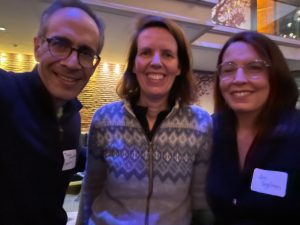
Author, with Nicole van Poppel (Cytoreason) and Dr. Jenifer Siegelman (strategic advisor)
A few learnings along the way:
First: technology is enormously enabling. Tools have extraordinary power. Think of the impact of the telescope, the microscope, the microchip, the calculus: all changed the questions we were able to ask of nature. But the key challenge with any powerful new technology — and gen AI is only the latest example — is making sure we leverage it without getting defined by it. The real danger is letting what the tools do well define what we think matters. In healthtech, that means we tend to focus on measuring, quantifying, and optimizing, rather than what might be most important to the people we’re trying to serve. As Kate Crawford astutely reminds us, we must not let the “affordances of the tools become the horizon of truth.”
Second: remarkable progress in the science of aging has highlighted the outsized value of basic lifestyle activities. There’s so much we can do to age better and live healthier. Not zany fads like rejuvenation pods and the like, but basic, common-sense things that tend to reduce what researchers call “inflammaging,” chronic low-grade inflammation associated with problems from cancer to dementia.
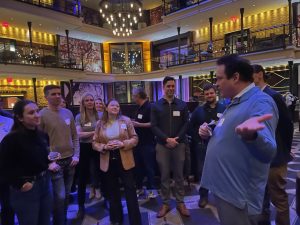
Event organizer, digital health investor/advisor Steven Wardell (right).
Obvious examples involve physiology: move regularly — Eric Topol has pointed out that a drug that delivered all the health benefits of exercise would be considered a medical breakthrough. Eat thoughtfully — avoid what nutrition researcher Kevin Hall describes as hyperpalatable, calorie-dense food; there’s lots of good data around the Mediterranean Diet, but common sense applies, and as Zeke Emanuel advises, on special occasions go ahead and eat your ice cream. Also — prioritize sleep; as Matthew Walker and others have taught us, it’s incredibly important.
Unfortunately, the remarkable advances in our ability to measure have led some to turn health into a game of relentless optimization of performance metrics like VO2 and various evolving putative measures of biological aging that may have value at the population level but aren’t yet validated on the individual level. There’s even a rejuvenation Olympics where biohackers compete for best biological aging score.
I’ve always favored a more capacious view of health — and the data seem to support this broader perspective. For example, while physiology is important, so are two other categories: connection/purpose and agency. The Harvard Study of Adult Development, now running over 85 years, has shown that warm relationships predict better cognitive and emotional health decades later. The Northwestern SuperAgers study — examining people in their 80s with memory as sharp as 50-year-olds — found that the single psychological factor distinguishing them from their peers was higher-quality positive relationships. And meta-analyses across more than 300,000 people show that stronger social connections are associated with a 50% increased likelihood of survival. And a higher sense of purpose has also been robustly associated with reduced mortality — there’s actually a great JAMA Network publication showing a dose-response relationship.
Finally, we get to the quality I’m especially captivated by: agency — essentially, your belief that you can impact the world around you. The data linking agency and optimism to better health are striking. Meta-analyses across more than 200,000 people show that higher optimism is associated with roughly a 35% lower risk of cardiovascular events and about 14% lower all-cause mortality — effect sizes in the same neighborhood as traditional risk factors like blood pressure or cholesterol. In the Nurses’ Health Study, women in the top quartile of optimism had nearly 40% lower risk of dying from heart disease or stroke over eight years. More optimistic people also appear to live about 10% longer, with 50-70% greater odds of making it to 85 or beyond. The American Heart Association’s 2021 Scientific Statement in Circulation formally recognized optimism and psychological well-being as cardiovascular health factors with quantified effect sizes, which I guess makes these ideas officially mainstream.
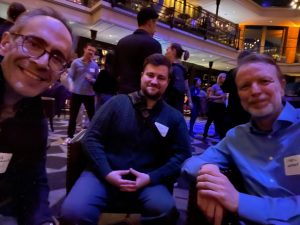
Author, with Alexander Webber (Virus Watcher) and Dr. Marc Herant (Recon Strategy).
Of course, these encouraging associations raise the real question: can we actually cultivate agency, or is it just a trait some people happen to possess? Because changing health behavior is incredibly hard. Angela Duckworth and Katy Milkman ran a massive study –- a “megastudy” — with over 60,000 participants testing dozens of behavioral interventions to boost gym attendance, and none of them worked particularly well — and experts had very little ability to predict which specific interventions would be effective. As Duckworth herself put it, “Behavior change is really *#$@ing hard” – and she’s a MacArthur Genius!
And yet — there are remarkable examples showing it absolutely can be done. Perhaps none more compelling than right here in Boston, just down the street from where we’re standing. The Diabetes Prevention Program, led by my diabetes clinical mentor David Nathan at MGH, demonstrated that a structured lifestyle intervention could reduce the incidence of type 2 diabetes by 58 percent — nearly twice the effect of medication. And the benefits have persisted over 15 years of follow-up. It’s one of the most important prevention studies ever conducted, and, as I see it, it’s all about cultivating agency.
And we’re seeing the same mechanism play out right now in a completely different context. David Kessler — former FDA Commissioner — has described the struggle to lose weight after a lifetime of trying as “a cycle of despair.” What the new GLP-1 medications have done for Kessler and many others, beyond the physiology, is restore the belief that they can actually succeed. That renewed sense of agency can create what I’ve called an “agentic dividend” that, if suitably cultivated, can be applied to other healthy pursuits, like exercising, getting health screenings, reconnecting with family, friends, and community. It has the potential to initiate a virtuous cycle.
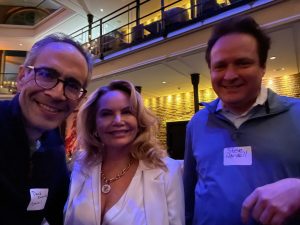
Author, with Molly Robb (talent partner) and Steven Wardell (digital health investor/advisor).
One important thing to say about agency before I close. This is emphatically not about “putting on a happy face.” Bad things happen. Terrible things happen. The deeper view of positivity — what Martin Seligman calls flourishing — is a combination of positive emotion, engagement, relationships, meaning, and accomplishment. It’s substantive, not superficial, and as he derisively explains, it’s absolutely not about “merriment.” Optimism can improve your odds, but it’s not a panacea. I think of it more as a resilience tool, one that encourages us to respond constructively and persistently — while being clear that bad outcomes don’t mean you didn’t smile enough. There’s a lot of contingency and bad luck in the world. Sh-t happens.
And that brings me to my final point. It’s precisely because of all that contingency that our ability to cultivate agency matters so much. Agency, as I’ve described it, is the motivational currency of health — the thing that allows us to push through despite the many obstacles and pervasive, ever-present uncertainty. As Seligman wrote in 2021:
“When do we try hard? When do we break out of our sloth and overcome barriers that seem insurmountable? When do we reach for goals that seem unobtainable? When do we persist against the odds? When do we make new, creative departures? These all require Agency — an individual’s belief that he or she can influence the world.”
There’s so much we can’t control — in every setting, everywhere. Our most underappreciated tool for improving our chances of getting the outcomes we want, and even more importantly – for living lives that feel full and capacious and ours — is building our sense of agency, our belief that we can impact the world around us, and coupling that belief with the pragmatic skills and mastery experiences that prove to us, in domains and across domains, that we actually can.
(Reading and resources related to agency and health can be found at KindWellHealth, here.)
• • •
Now to the career update/disclosure I mentioned upfront: I am joining Lore Health as Chief Medical Scientist. In this role, the passion project I’ve pursued (and maintain) at KindWellHealth will now also become my day job: leveraging emerging technology and behavioral science to cultivate agency and improve health at scale.
You may also like