The Best AI Health Innovators Have a Feel for People

David Shaywitz
Abba Eban observed in 1967 that wisdom tends to arrive only after all other alternatives have been exhausted. Happily, some of the most thoughtful innovators in AI and health seem to be getting there.
Over the last several weeks I’ve had an unusual opportunity to speak before and engage with audiences of investment bankers, investors, operators, and even political scientists, all of whom were interested in the same basic question: what will AI mean for healthcare and life sciences?
This deep, intense uncertainty reflects the near-universal appreciation that while change is in the air, no one can say with any certainty what the result of this change will be. To return to my favorite diagram from Carlota Perez describing the typical course of technology revolutions, we are living through the “frenzy.”

The Frenzy
For most, the future of AI isn’t just a matter of intellectual curiosity; investors want to know where value is likely to accrue; startup founders and big company executives are wondering whether the foundational labs are more likely to serve or consume (Twilight Zone style) their industries; policy experts want to anticipate the likely effect on economics and culture; students and trainees are wondering whether they will have jobs in five years, and what long-envisioned careers, like medicine, will look like — assuming of course they still exist.
In short, if you are feeling overwhelmed and confused, and perhaps just a bit giddy, take heart: so is everybody else.
This also means that projections of where the technology is headed offer far more value as a Rorschach test revealing personality and priors than they are reliable guides to the future. The argumentative, attention-seeking physician inevitably will offer an emphatic, provocative vision; the doomer ethicist will anticipate vexing moral hazards; accelerationist VCs will describe every industry as a technology stack, with their portfolio companies conveniently supplying its most important layers.
At the most recent conference, for example, a prototypic young founder dropped names and buzzwords as if he was Boston’s “PE Guy,” while large company executives described everything as a “journey.”
But beyond these entirely predictable excesses were also exceptional individuals offering perspectives that felt more like grounded clarity, articulated by impassioned tech innovators able to see beyond the power of the technology, and expressing a deep, nuanced, and yes even humble appreciation for the complexity of the health problems to be solved.
AI in the Life Sciences
Technology in general, and AI in particular, has been dazzling us with its ability to navigate complex challenges, from chess and go to driving, protein folding, and recent work on Navier-Stokes. Surely, enthusiasts reasoned, AI might finally rescue the discovery and development of new medicines from the benighted plodding of hide-bound biologists. The palpable vibe in some quarters was, “Move over, Boomers – we got this.”
How’s that working out so far?
As WSJ readers learned in the last week — and as TR readers of this column have been hearing for several years — “Silicon Valley Promises AI Will Cure Disease. Drugmaker CEOs Aren’t Buying It.” Biology is spectacularly messy, and while we’re awash in experimental laboratory data, the human data we most need are also the most sparse (as I’ve reviewed here).
At the Deerfield/GV AI Forum, to frame a day devoted to the challenges and opportunities in biopharma R&D, I led a session featuring two extraordinary entrepreneurs who I described as “forces of Nature” – Daphne Koller and Rosana Kapeller.
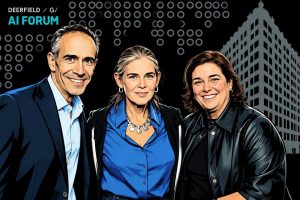
Author, with Daphne Koller and Rosana Kapeller, via AI photo kiosk at Deerfield/GV Forum
Kapeller, now an advisor at GV, was the founding CSO of Nimbus, a company that brought computation and drug hunting together with remarkable success. In 2023, a TYK2 program whose discovery she helped lead was sold to Takeda for $4B upfront, and up to $2B in potential sales-based milestones.
Koller, a computer science prodigy, certified MacArthur Genius and former professor who I often joke is probably the one who taught AI to half the Stanford grads in the Valley, took her talents to biology, and is the founder and CEO of insitro. (You can also listen to Luke’s fantastic “Long Run” interview of Koller, which just dropped.)
While our conversation largely followed the contours of my recent TR discussion, the most salient moment was when the conversation turned to what would distinguish the most successful companies in the AI era, especially as AI capabilities become widely available.
You might have expected an answer focused on access to data or familiarity with technology, but without missing a beat, Kapeller said that unquestionably, the most critical asset would be the quality of team, their depth of R&D experience, and their ability to work together effectively. Koller — an AI OG — agreed completely.
What’s more, when I asked Koller if she thought that the increasing number of biologists trained in AI would help, allowing both tech and bio smarts to exist in the same mind, she disagreed, emphatically. Koller said she detested the concept of “pipeline in a person.” (I wasn’t familiar with the phrase – recently popularized by Anthropic — although I understood the concept through its constant valorization on the must-listen NEJM-AI grand rounds podcast, hosted, perhaps unsurprisingly, by two remarkable “bilingual” experts, and representing a journal led by a third).
Yet here, both Koller and Kapeller emphasized the breadth of experience and the range of expertise successful R&D requires — and the very difficult challenge of creating an environment that respects and brings out the best of both.
Having emphasized for years that the successful application of powerful new technologies requires deep domain expertise, often acquired through years of lived experience, it was exhilarating for me to see how thoroughly these leaders seemed to have internalized this lesson.
One familiar failure mode here, as I’ve also frequently highlighted, is the tendency of tech-first powerhouses to feature an engineer-first culture that relegates biologists and physicians to second-class status as subject matter experts. An equally problematic failure mode, still common in large biopharmas, is to hive off AI experts as a specialized Geek Squad, of palpably lower status.
AI in Healthcare
The vital need to deliberately foster a culture that brings out the best of both biomedical and tech experts, in an environment of authentic mutual respect, reminded me of Dr. Amy Abernethy, whose experiences include Duke, Flatiron, the FDA, Verily, and now at Highlander Health. Creating a culture that makes all the collaborators equal is a non-trivial challenge, but also worth it, Abernethy has said. It is perhaps no surprise that Abernethy sits on insitro’s Board of Directors.

Dr. Amy Abernethy, Highlander Health
Abernethy has also distinguished herself by deeply understanding the problem to be solved, and ensuring that the problem, rather than technology, remains the core focus. For example, at the pioneering oncology real world data company Flatiron, Abernethy recognized the need for expert human data extractors (generally trained nurses, in this case) to ensure nuanced oncology data were accurately obtained.
On the second day of the AI Forum, I was struck by how much Dr. Nate Gross, OpenAI’s head of health, seemed to share Abernethy’s insistence on deeply understanding health’s problems before getting carried away by the possibilities of technology.
I first met Gross over a decade ago when I was advising Doximity, a company he co-founded with Jeff Tangney and Shari Buck. Doximity — known as the LinkedIn for doctors — distinguished itself in my mind by its remarkably intuitive understanding of physicians and their pain points.
Famously, this technology company introduced a feature that seemed almost comically retro: a free, personal fax number for every physician who wanted one. As Gross later explained, Doximity had initially hoped to kill the fax machine, but doctors pointed out that secure messaging was of limited use if the colleague they needed to reach wasn’t on the platform. So Doximity enabled physicians to send, receive, and even sign faxes from their smartphones, accommodating how medicine actually worked while making the experience considerably more convenient.
That feature was revealing because it required a peculiar sort of technological humility: a willingness to understand the healthcare environment on its own terms, including its frustrations and apparent absurdities, and to develop products around the problems people (physicians in this case) actually faced.

Dr. Nate Gross, OpenAI
Gross seems to possess an unusually well-developed feel for healthcare product — an appreciation of what patients and physicians actually need, how healthcare operates in practice, and where technology might genuinely help. It’s a sensibility I’ve long admired in the best healthtech entrepreneurs, combining empathy, domain expertise, and sophisticated product judgment.
In the same way that Kapeller and Koller were bringing value to biopharma R&D by cultivating drug developers and living their problems, rather than fetishizing (and having magical expectations around) a seductive, legitimately powerful enabling technology, so too was the mindset Gross seemed to bring to health.
(A quick aside – the importance of aspiring healthtech innovators “living their problems” was also highlighted by Abridge’s Michal Nedoszytko in the latest episode of the NEJM-AI Grand Rounds podcast.)
Foundation lab leaders seem given to extravagant predictions. Anthropic’s Dario Amodei has shared on X, “I think it will actually be possible to cure most human disease in ~5-10 years, as crazy as it may sound to ordinary people and frankly to biologists as well (I used to be one!).” Meanwhile (as TR readers will recall), OpenAI CEO Sam Altman has said that with AI, “we will see diseases get cured at an unprecedented rate.”
Given this backdrop, it’s easy to imagine a healthcare leader at a foundation company focused on how the emerging technology will supercharge medicine (before, presumably, obviating the need for it).
Yet at the AI Forum, Gross emphasized — and demonstrated a nuanced understanding of — the gaps in care, and all the ways intended care can fall short. Gross seemed particularly attuned to everything that happens between medical encounters: the difficulty of navigating a fragmented system, understanding and remembering instructions, and adapting medically sound recommendations to the particulars of an individual’s life. He envisions AI providing a kind of continuity of support that healthcare rarely offers today.
His remarks at the conference echo recent comments at Stanford, where Gross explained that physicians may develop care plans that are “medically very sound but operationally hard to execute” in the circumstances of a patient’s actual life.
Consider, Gross suggested at Stanford, someone with a diabetic foot ulcer whose favorite pastime is fishing. How should that patient reconcile the doctor’s instructions with an activity that matters to him?
More generally, Gross imagines AI becoming a kind of “super assistant,” helping patients understand and carry out care plans while navigating the myriad practical obstacles that can frustrate even the best medical advice.
The broader idea he’s championing seems to involve empowering patients to become more effective participants in their own healthcare, which involves a greater understanding of the particulars of their lives. As Gross explained in a separate interview, “context really matters in healthcare.” He envisions AI helping patients take “active captain-like roles in their own health,” working in partnership with their physicians and care teams, with a focus, it seems, on facilitating a lot of the underlying coordination that effective care requires.
At the recent conference, he described envisioning a role for AI like that of a thoughtful, attentive spouse, who has a deep understanding of context, an inclination to offer proactive advice, and the judgement to sense when and how best to do this.
Bottom Line
Disease is complex. Health is complex. AI is increasingly poised to help. But the most effective and durable solutions will require humility about the limits of even our most powerful technologies, along with genuine curiosity — and affection — for human biology and behavior, which rarely fit neatly into our insistently reductive models.
You may also like